In This Article
(Click the links below to move easily to sections of this article)What is a Sense of Urgency
Why is Urgency Important to Change?
How to Create a Sense of Urgency With Your Team
Chart: John Kotter’s Eight Step Model for Leading Change
Video: Leading Change Step 1
Quiz: How Well Do You Understand Urgency
Scholarly Citations for this Article
Leading Change in the Workplace Article Series

Get a FREE infographic that summarizes Kotter's Leading Change Model.
What is a Sense of Urgency
 The results of a classic report by IBM Global Study, The Enterprise of the Future, showed that organizations have been flooded with change for some time and many were finding it hard to keep up. Not much has changed since this time!
Like many organizational realities, the flood of change organizations face brings both good and bad news.
The results of a classic report by IBM Global Study, The Enterprise of the Future, showed that organizations have been flooded with change for some time and many were finding it hard to keep up. Not much has changed since this time!
Like many organizational realities, the flood of change organizations face brings both good and bad news.
The bad news is that the rapid rate of change will not subside. It will only increase. The good news is that John Kotter’s Eight Step Model for Leading Change (#CommissionsEarned) remains a viable approach.
I will address each of his eight steps in separate articles. I’ll start with the first step of Kotter’s model, Creating a Sense of Urgency.
So, what is a sense of urgency?
Two explanations of the word urgency are useful for understanding what leaders do as agents of change:
- First, leaders take actions that capture the attention of critical organizational stakeholders.
- Second, leaders explain the importance of making speedy changes to the existing condition.
When leaders create a sense of urgency, they alert the organization that change must occur and the leaders also begin preparing the organization for the change process.
When leaders create a sense of urgency, they alert the organization why change must occur. Share on XWhy is Urgency Important to Change?
 Why is urgency important to a change effort? Urgency is important because meaningful organizational change cannot occur without the cooperation of the affected stakeholders. This is why creating a sense of urgency for a needed change is the first step leaders must take to gain the cooperation of management and employees.
Leaders create a sense of urgency by both selling the value of a future state to organizational stakeholders and making the status quo a dangerous place for the stakeholders to remain. In effect, senior leaders create a compelling narrative that tells stakeholders why it is not in their best interest for the organization to stay in its current state.
This is often done through frank discussions about the current market and competitive realities, sharing relevant financial and customer data, and discussing opportunities and crises facing the organization. Communication is critical and the communications about the urgent need for change must be honest. A manufactured sense of urgency will soon be seen for what it is and this will doom a change effort to mediocrity.
With a sense of urgency, the organization understands why change is no longer optional. Share on XHow to Create a Sense of Urgency With Your Team
 There are several steps leaders can take to create a sense of urgency and gain the commitment of managers, employees, and other stakeholders.
They include the following:
- Showing the seriousness of leadership commitment to the coming change by eliminating obvious waste;
- Sharing bad news with the organization;
- Requiring managers and employees to talk directly regularly with unhappy suppliers, customers, and other stakeholders to understand their concerns;
- Sharing data throughout the organization that supports the claim that change is necessary; and
- Ensuring organizational decisions and management actions are in agreement with change communications (walk the talk).
To lead a change effort and gain the cooperation of necessary stakeholders, the first step leaders must take is to create a sense of urgency. It requires clear and honest communications that create a sense of urgency rather than a sense of doom. By creating both a compelling picture of a desired future and the danger of accepting the status quo, leaders greatly improve their chances of gaining the commitment of organizational stakeholders for a necessary change effort.
You cannot create urgency without effectively communicating to your team why change is necessary. Share on XChart: John Kotter’s Eight Step Model for Leading Change
A chart of John Kotter’s Eight Step Model for Leading Change follows:
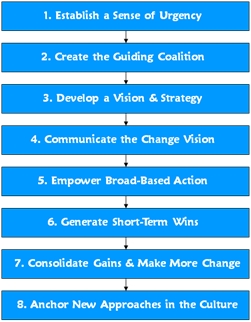
Chart Data Source: John P. Kotter, Leading Change (#CommissionsEarned), Harvard Business School Press
In my next blog post, I will address Step 2 of the model: Creating the Guiding Coalition.
Get a FREE infographic that summarizes Kotter's Leading Change Model.
Video: Leading Change Step 1
*Music for this video is courtesy of www.musicrevolution.com.Quiz: How Well Do You Understand Urgency
*Music for this video is courtesy of www.musicrevolution.com.
Scholarly Citations for this Article
This article from Management is a Journey has been cited in the following scholarly research articles:
- Global Journal of Economics and Finance: The Shut Down of Jet Airways | Long Island University (Ashmita Tikku and Herbert Sherman, Ph.D.)
- Doctoral Project: Revitalizing and Changing Culture at North Baptist Church in Phoenix, Arizona | The Southern Baptist Theological Seminary (Garcia, Oscar Noe)
- Doctoral Dissertation: A Cross-Sectional Study of Union Operator and Front-Line Supervisor Perception of Culture and Leadership in a Northeast Petrochemical Refinery | Wilmington University, Delaware (Durbano, David A)
Leading Change in the Workplace Article Series
- Leading Change (Step 1): Creating a Sense of Urgency
- Leading Change (Step 2) – Create the Guiding Coalition
- Leading Change (Step 3) – Develop a Change Vision and Strategy
- Leading Change (Step 4) – Communicate the Change Vision
- Leading Change (Step 5): Empower Broad Based Action
- Leading Change (Step 6) – Generate Short-Term Wins
- Leading Change (Step 7) – Consolidate Gains and Implement More Change
- Leading Change (Step 8) – Anchor Change in the Culture
- Kotter’s Eight Step Leading Change Model
When creating a sense of urgency, leaders explain why keeping the status quo is dangerous and why making change provides a more desirable future for the organization. Share on X
This article is accurate to the best of the author’s knowledge.
Content is for informational or educational purposes only and does not substitute for professional advice in business, management, legal, or human resource matters.
