Why are Goals Important
Setting goals is an important element of performance management and overall organizational productivity. If constructed correctly, goals can give employees a clear standard of what acceptable performance looks like. When goals are poorly constructed, however, employee motivation is harmed.
Poorly constructed business goals frustrate employees as they have no consistent method for assessing how well they are meeting workplace requirements. Share on XWhat Are SMART Goals
Goals should be SMART and this familiar acronym provides a useful approach for constructing goals. So what exactly are SMART goals?
SMART stands for specific, measurable, action-oriented, realistic, and time-oriented. When a goal includes all of these five elements, it eliminates confusion and it provides a clear standard that you can use to measure performance.
The SMART acronym for developing goals means the following:
- Specific: avoids broad statements
- Measurable: Identifies when target is reached
- Action-Oriented: specifies what must be done
- Realistic: is challenging but not unrealistic
- Time-Oriented: imposes deadline requirements
The difference between SMART goals and regular goals is significant. Consider the following two goals for a customer service representative who handles incoming customer calls about a company’s product:
- Regular goal: Increase customer satisfaction survey ratings.
- SMART goal: Increase customer satisfaction survey ratings for incoming calls from 50% to 75% by quarter 4 of the current year.
The first goal is clearly vague and it sets up the manager and employee for disagreement over what constitutes an acceptable increase in the customer satisfaction rate. Let’s use an exaggerated example to show why this first goal is incomplete.
Assume that a customer service representative did get a survey ratings increase from customers in how he handled their calls. Again, for exaggeration let’s say that it’s a 1% increase and that it took two years to occur.
A 1% bump is an increase. But, is 1% the goal the manager has in mind?
What about the timing for this goal? If it takes the employee two years to increase his rate, is this an acceptable period of time?
In both cases, the answer is clearly no. Some might say the employee is to blame. But is he?
This is the problem with poorly written goals: they do not provide a clear path to success. With the regular goal, the employee was not given a clear performance goal to achieve.
Let’s compare the regular goal to the SMART goal now.
With the SMART goal, the employee knows how much of an increase he has to make in his customer service rating and how long he has to make it happen. With this information, he can make some decisions on what he needs to do to meet this performance goal.
SMART goals eliminate confusion and they provide a clear standard for measuring performance. Share on XWhy SMART Goals Are Important
SMART goals are an important tool in your management toolbox. They are helpful for coaching, motivation, development, and performance management purposes. Done correctly, they can have a positive impact on your organizational productivity and your management standing in your organization.
How to Make SMART Goals
The following chart provides an overview of the elements for constructing SMART goals:
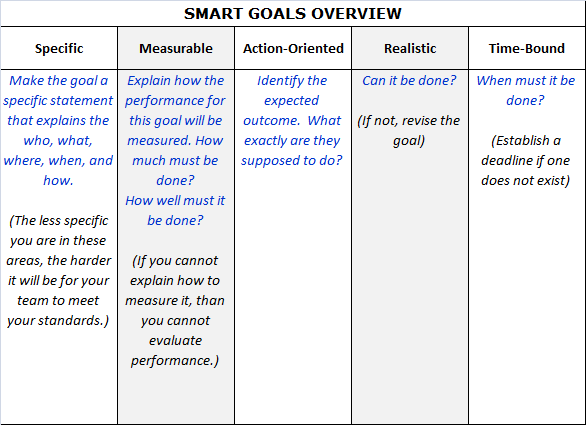
Use SMART goals to improve the productivity of your work group.
A final tip: Allow your employees to help you develop their own SMART goals and you will greatly increase the power of this tool. By allowing them to participate, they become co-owners with you of the goals. And, as we all know, we treat the car we own better than the car we rent for a few days!
When employees participate in setting their own business goals they are more likely to meet them. Share on X
This article is accurate to the best of the author’s knowledge.
Content is for informational or educational purposes only and does not substitute for professional advice in business, management, legal, or human resource matters.
