The Power of the Rule of Three
Okay, I’ll admit the title of this article might be a bit much. In actuality, there are more than a few people who know about Lewin’s Change Leadership Model! It’s just that this model is not foremost in many people’s minds when they speak of a strategy for leading change in an organization.
The value of knowing and understanding Lewin’s Change Leadership model comes with its simplicity. It’s a strategy that covers three areas. And, there’s something complete about the number three!
Look around you and you’ll see that the number three is in use everywhere: physics has Newton’s Three Laws of Motion; literature has the Three Musketeers; and computer programing has its own three use rule for replicating coding. In fact, there’s no limit to the power of the number of three in expressing ideas. Multiple disciplines from economics to aviation use their own variation of three elements to develop their own rules to explain behavior. This has led to various forms of different Rules of Three to explain complex concepts. Economists, scientists, mathematicians, aviators, musicians, photographers, computer programmers, and marketers all have their own Rules of Three.
You Might Be Wondering: Where’s the Rule of Three for Effective Change Leadership?
Good question!
If you look at all of the change leadership work that exists, you can’t help but wonder the following:
- Why can others apply the Rule of Three to their industries while change leadership professionals cannot?
- Why aren’t the fundamentals of effective leadership simplified and expressed in some form of a Rule of Three?
- If a leadership Rule of Three does exists, why isn’t it discussed more?
The fact is that existing change leadership models can be simplified to a powerful Rule of Three. Surprisingly, this rule has existed for seventy years (even if it isn’t discussed much).
However, if you look at what others have done, you can see that their models build on this foundation of knowledge.
So, what’s this change leadership model? It is Kurt Lewin’s Change-As-Three-Steps (CATS) model. It’s also known by its three steps: unfreeze, change, and refreeze.
When you need to get others to change the first thing you have to do is convince them that what you want to do is really necessary. You have to unfreeze things! Share on XWhat is Lewin’s Unfreeze, Change, and Refreeze Model
While some criticize Kurt Lewin’s three step model as being too simplistic, the truth is that this model defines the fundamentals of change leadership effectively. Further, it applies to managers at all levels.
The problem is that Lewin’s model is often lost in the noise of Internet sites. It’s also lost as leadership professionals rush to publish and promote their own business books on change. Many respected change experts will readily admit however that Lewin’s model is the foundation for much organizational development work that occurs today.
When you need to get others to change the second thing you have to do is get those who are affected by what you want to do to help you implement the change. You have to change things! Share on XSince a picture is worth a thousand words, I’ve put together a chart below that explains Lewin’s model:
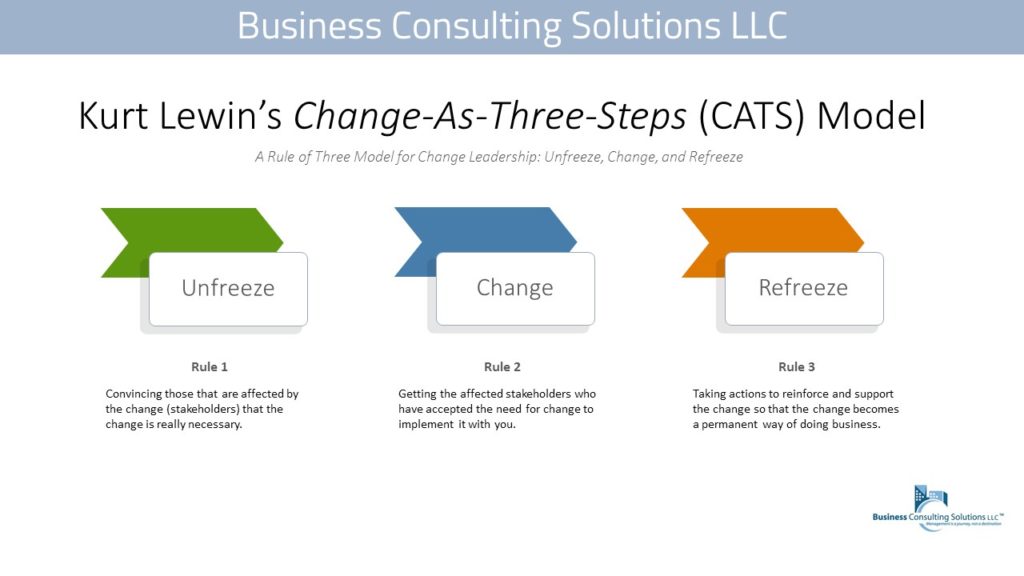
3 steps for change: unfreeze your organization, change it to what you want, then refreeze it. Share on X
How to Apply Lewin’s Unfreeze, Freeze, and Refreeze Model to Your Change Efforts
If you’re looking to apply Lewin’s model to the change that you need to make in your organization, then you’re probably thinking something like the following about my article:
This is nice information Robert! But, I need more specifics. First, how exactly am I supposed to convince others that change is necessary? Second, after I’ve done that, how do I get them to work with me to implement it? Finally, how do I make whatever changes are necessary in the organization to reinforce it?
I want you to know that I feel your pain! Lewin’s three step model can benefit from more detail. It’s best use is as a strategic tool to get organizational stakeholders to understand and agree where to focus their efforts.
The good news is that you can expand on Lewin’s Rule of Three Change Model by using the work of other change experts who further defined how to lead organizational change.
John Kotter is a widely recognized change guru whose work is often cited and used for change efforts.
Kotter defines the process of leading change in eight steps. However, if you categorize Kotter’s steps, you can see that they fit into Lewin’s Rule of Three for Change Leadership. The following chart explains further:
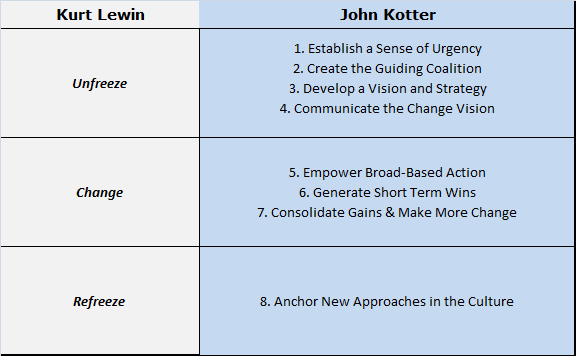
To read my series of articles on Kotter’s Leading Change Model, click here.
Video: Kurt Lewin’s 3-Step Change Model — Unfreeze, Change, Refreeze
When you need to get others to change, the last thing you have to do is to reinforce and support what you want done with concrete actions. You have to refreeze things! Share on X
This article is accurate to the best of the author’s knowledge.
Content is for informational or educational purposes only and does not substitute for professional advice in business, management, legal, or human resource matters.
